
Your Passivhaus home on the Costa del Sol
A home that barely uses energy is not a utopia. It is the result of designing it properly from the start — with proven criteria, real calculation tools and a certified architect who guarantees it.
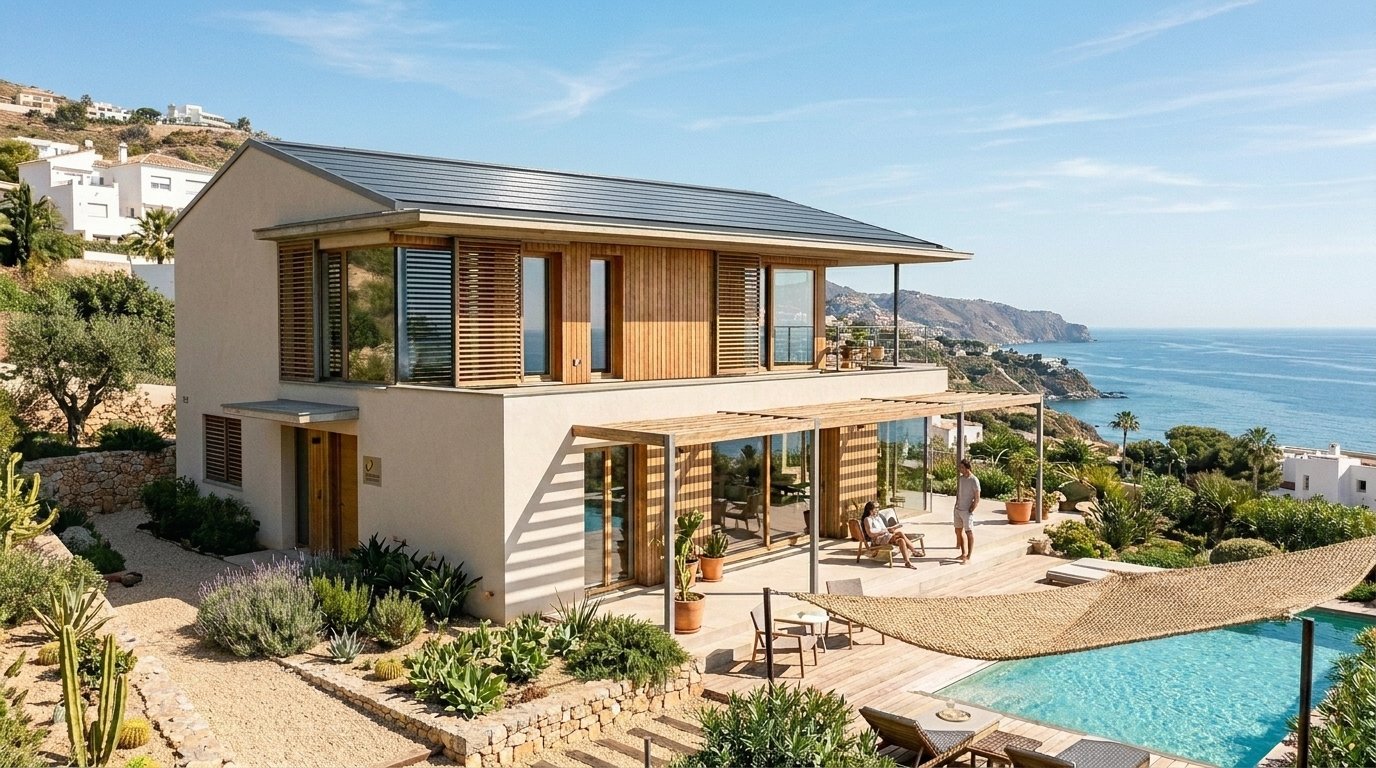
A home that takes care of you, not the other way around
The Passivhaus standard is not marketing or a label. It is the most audited building methodology in the world for achieving homes where you always feel comfortable and that barely consume energy. Translated into your everyday life, here is what changes:
Certified Passivhaus architect
Our founding architect is a Passivhaus Designer certified by the Passive House Institute (Darmstadt, Germany) — the organisation that created this standard and certifies the professionals who know how to apply it.
This means we do not outsource the energy design or bolt it on at the end. We integrate it into the DNA of your project from the very first sketch.
Perfect temperature, without touching the thermostat
No draughts, no cold in winter or stifling heat in summer. The home maintains a constant, pleasant temperature all year round, without oversized heating and cooling systems.
Clean air around the clock
Controlled mechanical ventilation continuously renews the air, filtering dust, allergens and outdoor pollution. Especially relevant if you have children, pets or suffer from allergies.
Absolute silence
Super-insulation and airtightness not only conserve energy — they also block exterior noise in an extraordinary way. Your home becomes a haven of peace.
Negligible energy bills
Savings of up to 90% on heating and cooling compared to a conventional home. Not magic — applied physics. An investment that pays for itself over the lifetime of the building.
The 5 principles that make it possible
A Passivhaus home has no tricks. It works because it rigorously applies these five criteria from design through to construction:
High-performance insulation
A seamless thermal envelope that eliminates thermal bridges and turns the home into a high-efficiency thermos.
Triple-glazed windows
High-performance frames and glazing that retain heat in winter, protect from heat in summer and block exterior noise.
Airtightness
No unwanted infiltrations. Every joint, every service penetration, controlled. Air enters and leaves only where it is designed to.
Heat-recovery ventilation
Continuous fresh air that does not waste the energy already stored in the home. The building breathes efficiently.
No thermal bridges
Every construction detail reviewed to eliminate heat leaks. The temperature is uniform across the entire surface.
Frequently asked questions about Passivhaus
Yes, and particularly well-suited. The Passivhaus standard works in all climates. In Málaga, the main challenge is not cold but summer heat. A Passivhaus home in a Mediterranean climate dramatically reduces the need for air conditioning and keeps the interior cool with minimal energy consumption.
The additional cost is typically between 5% and 15% over comparable conventional construction. That premium is offset by energy savings over the lifetime of the building, while also delivering a home with higher asset value, a better energy rating and significantly superior comfort.
Yes. The EnerPHit standard is specifically designed for deep energy retrofits. The requirements are somewhat more flexible than for new builds due to the constraints of existing structures, but the goal is the same: substantially improving comfort and drastically reducing energy consumption.
A home can achieve a good energy rating (A, B…) for various reasons, not always related to real comfort. The Passivhaus standard is a rigorous design methodology with independent verification through an airtightness test (Blower Door Test) that confirms the building performs as calculated. It is not just a label: it is a verifiable result.
It is a credential awarded by the Passive House Institute in Darmstadt, Germany — the organisation that developed this standard worldwide. Certified professionals have completed specialist training and passed an official examination. It guarantees that the person designing your home has the specific technical competences to do so correctly, using internationally recognised calculation tools.
No. The Passivhaus standard can be applied to any type of home, regardless of budget. The final cost depends on the quality level and finishes chosen, not on the energy standard itself. Over the long term, a Passivhaus home with standard materials works out cheaper than a conventional high-spec home.
The certification process starts with the project design and concludes after construction with on-site verification, including the Blower Door Test. The design itself does not take longer than a conventional project if the architect is trained to work to this standard from the outset — which is exactly our case.
Let's talk about your project
Tell us what you have in mind and we will get back to you with no obligation.